
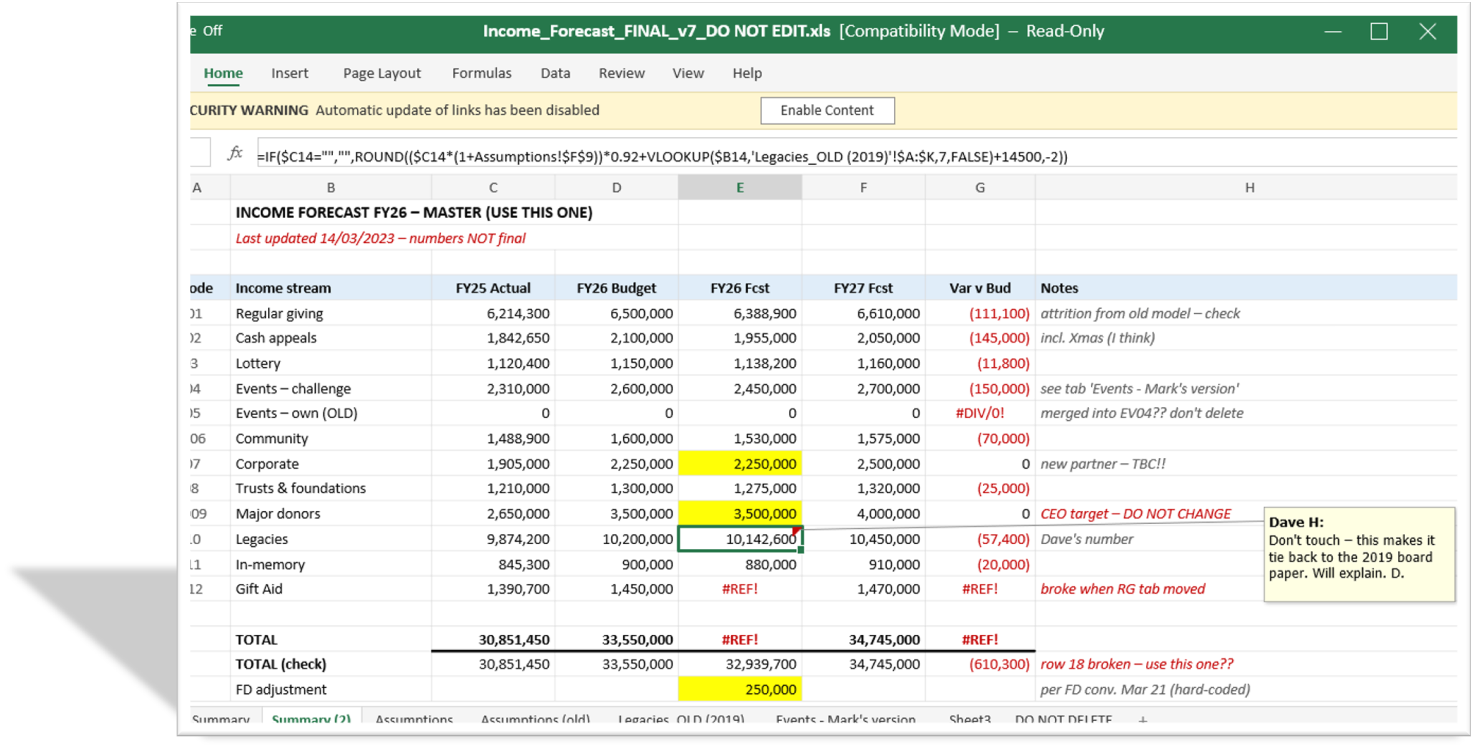
A few weeks ago I co-presented a conference talk with Prostate Cancer UK on income forecasting. We opened with a show of hands. Who has a file called something like Income_Forecast_FINAL_v7_DO NOT EDIT.xls? Read-only, full of hard-coded fixes nobody remembers adding, and understood by precisely no one.
A lot of hands went up.
It’s easy to look at your own messy forecast and assume everyone else has it sorted. They don’t. Seeing a room full of people recognise the same spreadsheet was reassuring. Common problems are common for a reason. Fundraising Directors have the same pressures. A board deadline, a new business case to build and targets hit. They often push people towards the same quick fixes.
And we made the point that the problem wasn’t Excel. We discussed five principles to approach forecasting with. Starting with not taking things away. Because removing things feels risky and adding them feels rigorous but it’s what we should be doing.
The principles
- More variables isn’t the answer. Find the few things that really drive income. Flex each input by a realistic amount; if the forecast barely moves, it isn’t a driver.
- Design for the users. Fundraisers want to know if they’ll hit budget and what they can change. Can they find their number and explain it without a meeting with the person who built the model?
- Write your assumptions down. Who changed what, when and why. It turns a fortnight of arguing into a five-minute conversation.
- Build in modules. Each income stream stands on its own, and the summary just adds up.
- Separate the baseline from the target. Keep what you expect separate from what you hope. The gap between them is the useful discussion about budgets.
On the day we demoed our new web-based forecasting model, which has these principles at its heart. But none of this needs special software. You can do all of it in a spreadsheet. It’s about how a model is built and who it’s built for.
We closed with three questions for your forecast:
- Could someone else update this safely?
- Can you see the inputs and assumptions?
- Does it show the honest baseline separately from our hopes?
If the answer’s “er…”, you’re in very good company. Thanks to the Prostate Cancer UK team for sharing their side so openly, and to everyone who put their hand up.
If you would like to explore what the new forecasting model looks like you can try the free version on the website here, or drop us a line and we can show you the fully licensed version which includes modules for your existing file plus retention and cash appeals, as well as acquistion activity to give you the full picture for planning ahead.
Author: Andrew Sargent, 2026 © Sequoia-Insights.com